
DME Billing Guidelines for Medicare, Medicaid, and Private Insurance: A Complete 2026 Guide for Providers Durable Medical Equipment (DME) billing continues to evolve in 2026, with stricter documentation requirements, increased audit activity, and expanded electronic claim monitoring across payers.
Whether you bill Medicare, Medicaid, or private insurance carriers, compliance is no longer optional—it’s mission-critical. Providers who fail to follow updated billing guidelines face claim denials, payment delays, recoupments, and even audits. On the other hand, those who streamline documentation, coding accuracy, and payer-specific compliance processes can improve reimbursement speed and reduce administrative burdens. This 2026 guide walks you through essential DME billing guidelines across major payer types—and how partnering with experts like TueCa RCM™ can help you stay compliant and profitable.
Table of Contents
Understanding DME Billing in 2026
Durable Medical Equipment includes medically necessary items such as:
- Oxygen equipment
- Wheelchairs and mobility devices
- CPAP and BiPAP machines
- Hospital beds
- Orthotics and prosthetics
- Diabetic supplies
Because these items are high-cost and often long-term rentals, payers impose strict documentation and medical necessity requirements. In 2026, payers are focusing on three main areas:
- Medical necessity validation
- Proper coding and modifiers
- Pre-authorization and documentation tracking
Let’s break down each payer category.
Medicare DME Billing Guidelines (2026)
Billing DME to Centers for Medicare & Medicaid Services (CMS) requires close adherence to Medicare Part B rules.
- Supplier Enrollment & Accreditation
To bill Medicare, DME suppliers must:
- Be accredited by a CMS-approved accrediting organization
- Have a valid National Provider Identifier (NPI)
- Meet DMEPOS supplier standards
Failure to maintain compliance can result in revoked billing privileges.
- Medical Necessity & Documentation
Medicare requires:
- A detailed written order (DWO) before claim submission
- Face-to-face evaluation (for certain items)
- Proof of continued need for rentals
- Correct HCPCS codes and modifiers
In 2026, CMS continues to emphasize documentation consistency between physician notes and claim forms. Discrepancies trigger automatic denials.
- Prior Authorization Requirements
Certain DME items remain subject to prior authorization. Submitting incomplete documentation will delay approvals. Providers should verify:
- Diagnosis code alignment
- Treatment history
- Physician signatures and dates
- Competitive Bidding Areas
Some regions remain subject to competitive bidding rules. Payment rates may vary by location. Medicaid DME Billing Guidelines (2026) Unlike Medicare, Medicaid programs vary by state. Each state Medicaid agency sets its own reimbursement rates and prior authorization processes.
Key Medicaid Considerations:
- State-Specific Fee Schedules
Always confirm your state’s allowable rates and coverage limitations.
- Mandatory Prior Authorization
Many states require authorization for:
- Power mobility devices
- Customized orthotics
- High-cost DME items
- Documentation & Medical Justification
States often require:
- Physician’s prescription
- Detailed treatment plan
- Functional limitation documentation
- Managed Medicaid Plans
In 2026, more Medicaid beneficiaries are enrolled in managed care plans. This means billing rules may differ from traditional Medicaid fee-for-service. Providers must verify coverage and authorization requirements for each managed care organization.
Private Insurance DME Billing Guidelines (2026)
Private insurance billing is often more complex because each payer has unique policies. Common requirements include:
- Pre-authorization for most DME
- Rental vs. purchase determination policies
- Medical necessity review committees
- Strict documentation standards
Many private insurers are increasing utilization management programs, meaning documentation must justify the lowest-cost appropriate option. Common Private Payer Pitfalls
- Using outdated fee schedules
- Missing modifiers
- Incorrect place-of-service codes
- Not confirming in-network status
Denied claims often result from small documentation inconsistencies.
Coding and Modifiers: Critical in 2026
Accurate HCPCS coding remains the foundation of DME billing. Important considerations include:
- Use of appropriate NU (new equipment), RR (rental), or UE (used equipment) modifiers
- Correct diagnosis linkage
- Proper frequency limits
- Replacement vs. repair codes
Payers increasingly rely on automated systems to flag irregular billing patterns. Even minor coding errors can lead to audits. 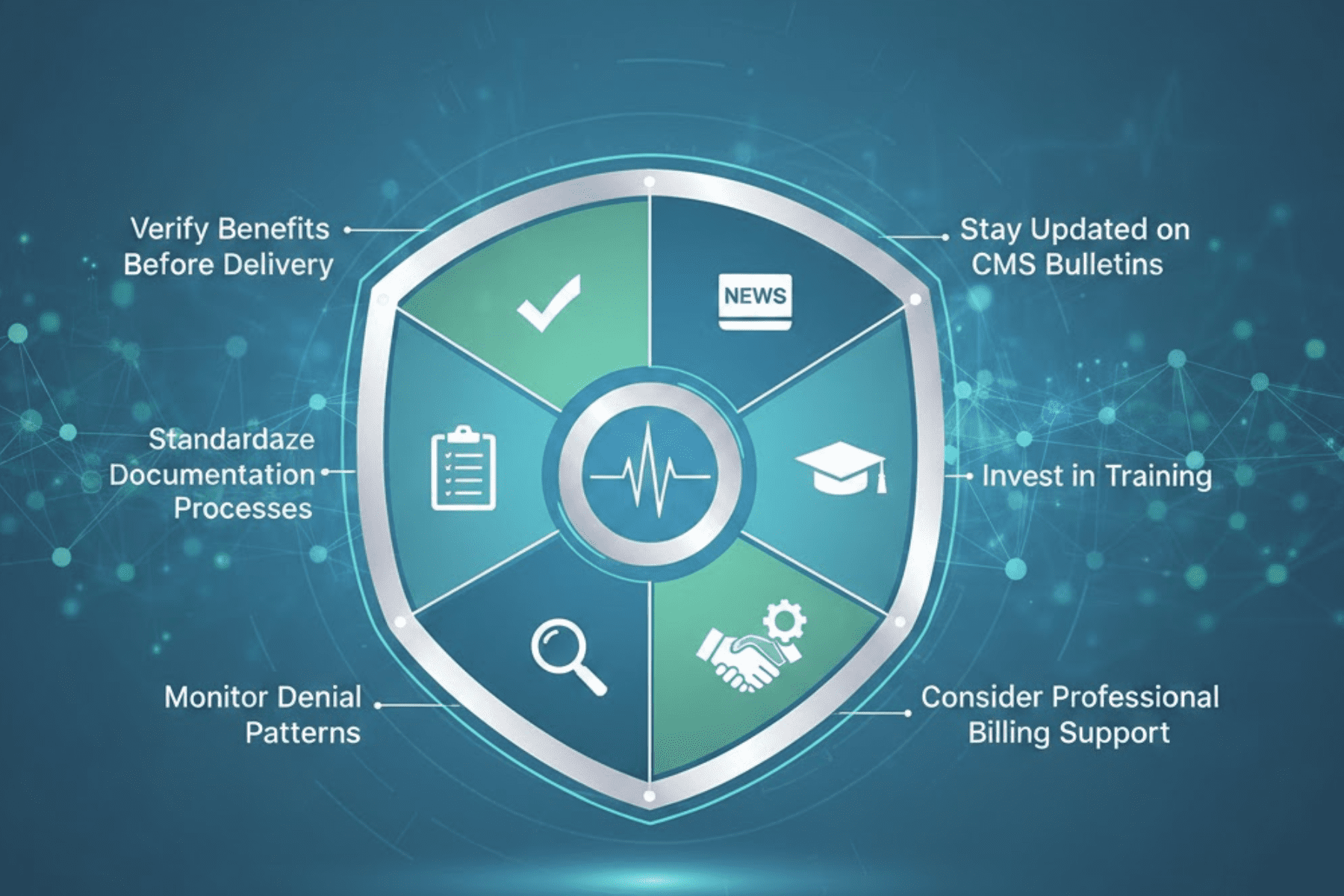
Best Practices for DME Providers in 2026
To stay ahead this year:
- Verify Benefits Before Delivery
Always confirm coverage, authorization, and patient responsibility prior to equipment distribution.
- Standardize Documentation Processes
Create internal checklists to ensure physician orders and patient records align.
- Monitor Denial Patterns
Track common denial reasons and correct systemic issues.
- Stay Updated on CMS Bulletins
Review regular updates from the Centers for Medicare & Medicaid Services to avoid compliance gaps.
- Invest in Training
Coding and billing staff must stay current on HCPCS updates and payer policy changes.
- Consider Professional Billing Support
Outsourcing to experienced services like TueCa RCM™ can significantly reduce administrative burden.
Revenue Optimization in a Tightening Regulatory Environment
With reimbursement rates under pressure and documentation scrutiny increasing, DME providers must prioritize operational efficiency. Revenue growth in 2026 doesn’t necessarily come from increasing patient volume—it often comes from:
- Reducing claim rejections
- Shortening reimbursement cycles
- Minimizing write-offs
- Improving patient collections
Professional billing management can strengthen your revenue cycle and reduce costly compliance mistakes.
Conclusion
DME billing in 2026 is more complex than ever. Providers must navigate evolving regulations from Medicare, state-level Medicaid programs, and private insurers—all while maintaining strict documentation standards. Success depends on proactive compliance, accurate coding, proper authorization tracking, and continuous monitoring of payer updates. Partnering with experienced professionals like TueCa RCM™ allows DME providers to remain compliant, reduce denials, and protect revenue in a challenging reimbursement landscape. Staying informed, organized, and strategic will be the key to sustainable growth in 2026 and beyond.
Frequently Asked Questions
What is the biggest DME billing challenge in 2026?
The biggest challenge is maintaining proper documentation for medical necessity. Payers are increasing audits, and even minor inconsistencies between physician notes and claims can lead to denials or payment recoupments.
Does Medicare require prior authorization for DME?
Yes, certain DME items require prior authorization under Medicare rules. Providers must submit complete documentation before delivering equipment to avoid payment delays or claim rejections.
How is Medicaid billing different from Medicare?
Medicaid billing varies by state, with different fee schedules, authorization requirements, and coverage policies. Providers must review state-specific rules and managed care guidelines before submitting claims.
Why are private insurance DME claims often denied?
Private insurers have unique policies and strict pre-authorization requirements. Claims are often denied due to missing documentation, incorrect modifiers, or failure to verify coverage beforehand.
What documentation is required for DME billing?
Typically, you need a physician’s order, proof of medical necessity, diagnosis codes, delivery confirmation, and supporting clinical notes that justify the equipment prescribed.
How can providers reduce DME claim denials?
Providers can reduce denials by verifying benefits upfront, ensuring documentation matches claim details, tracking authorization approvals, and conducting internal compliance audits regularly.
What role does TueCa RCM™ play in DME billing?
TueCa RCM™ helps manage claim submissions, authorizations, denial appeals, compliance monitoring, and revenue cycle optimization, allowing providers to focus more on patient care.
Are DME audits increasing in 2026?
Yes, both federal and private payers continue increasing audit activity in 2026, especially for high-cost and frequently billed equipment. Proper documentation and coding accuracy are essential to avoid penalties.